
Ungendering the Canon
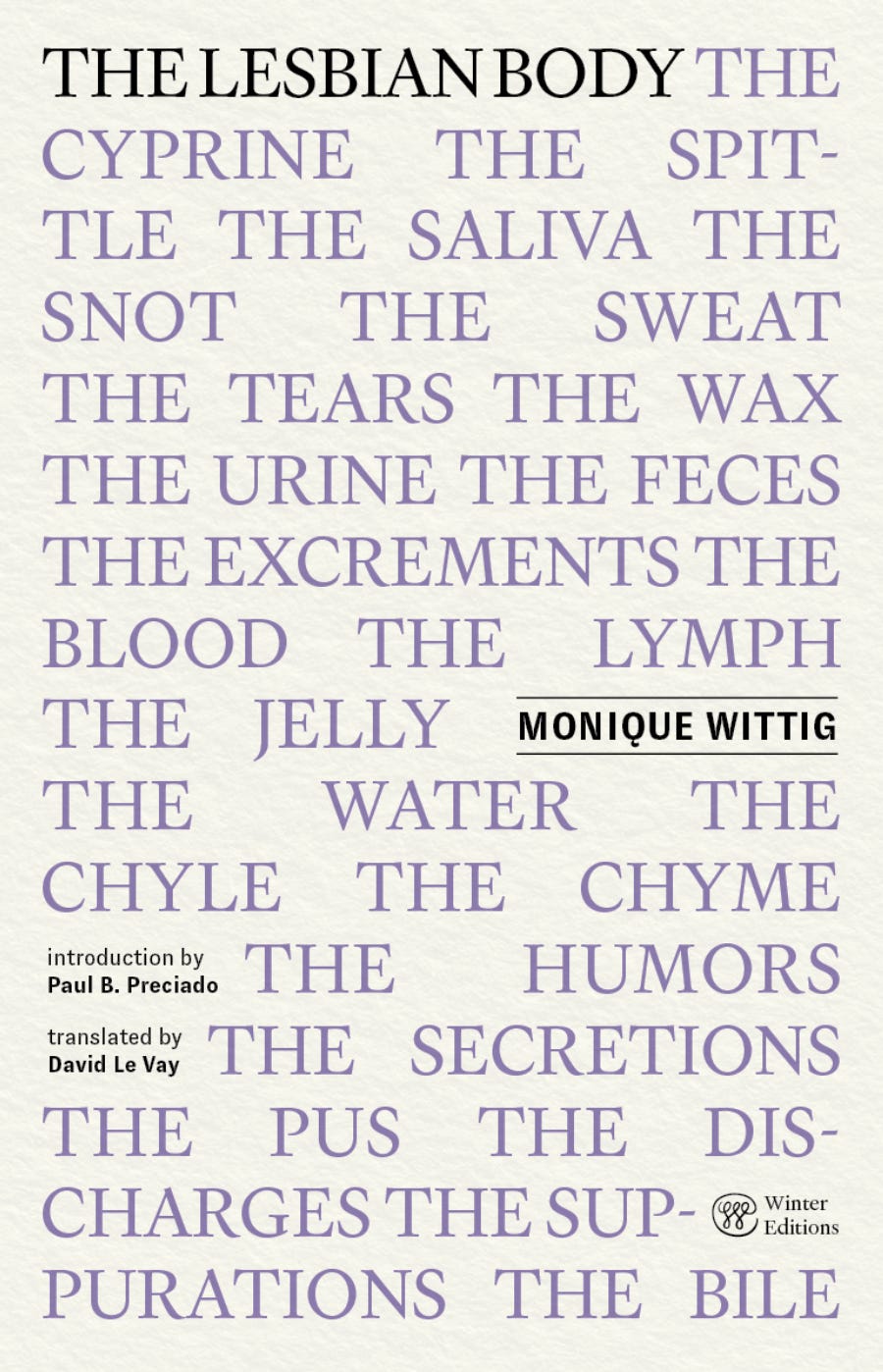
Review of Le Corps Lesbien / The Lesbian Body by Monique Wittig, Introduction by Paul B. Preciado, Translated by David Le Vay
.
What does it mean to write the body when language has been preemptively gendered? When so-called canonical texts are stripped of reference to your existence and bear the marks of imposed patriarchy and heterosexuality?
How is it possible to write at all when your access to other worlds comes fragmented in remnants of Sappho? A singular work composed of polyvocal fragments, The Lesbian Body reframes European and Eurasian mythology through Franco-lesbian feminist consciousness. This work deconstructs, often literally, Greco-Roman and Middle Eastern-North African patriarchal origin hi/stories to create a loose alliance between Sapphic and Franco-European lesbian feminist ontologies, cosmogonies, and epistemologies.
Wittig explicitly references influences including Sappho, Ovid, Homer, the New Testament, and French authors including Baudelaire. The work also shares a resonance with Scottish folklorist James George Frazer’s The Golden Bough, a rewriting of mythology and cosmogony — where Frazerʻs work traces power transfer from father to son, Wittig’s power transfer is from patriarchy to lesbian and feminist ways of knowing and being, via structural revolution.
The Lesbian Body also shares a certain sensibility with Dakota scholar and creative Dr. Kim TallBear’s Critical Poly 100s, a series of 100-word erotic poems embodying a multiplicity of human and more-than-human relations, as TallBear says, “I have multiple human loves, but the prairies and their rivers and skies are the most enduring loves of my heart.” Wittig’s landscapes and seascapes similarly form living elements of The Lesbian Body. Wittig plays with the embodiment of the fragment, as the form in which Sappho’s work has been partially transmitted to current European cultures, as well as engaging in the disembodiment and dismembering of static forms of gender and genre.
The Lesbian Body takes the form of 113 fragments, all around one page in length, interspersed with eleven interruptions of two facing pages in large capital letters listing elements and anatomical features of the lesbian body, such as “THE CYPRINE THE SPITTLE THE SALIVA THE SNOT THE SWEAT,” which also appears on the front cover of the work. Each fragment deconstructs a mythological origin story through the perspective of two interchangeable lovers, often literally dismantling the story, the lovers, and the environment in which the fragment takes place.
This literary and philosophical strategy intimately resembles elements of poems such as “Une Charogne” (“Carrion” or “A Carcass”) from Charles Baudelaire’s Les Fleurs du Mal, in which the narrator claims to be able to retain the forms of loves even when the body of the love has decomposed and become a carcass, “Que j’ai gardé la forme et l’essence divine / De mes amours décomposés!”
Wittig pushes against the confines of the 20th century French language, in which even “le corps lesbien,” or the lesbian body is grammatically marked as a male noun. She also plays with the language and with gender by never using words such as woman or man, male or female, preferring to use the plural “elles,” the feminine plural “they,” which occasionally creates translation challenges due to the lack of an all female plural “they” in current English.
This version of David Le Vay’s translation has been updated to remove all instances of “women” as a translation for “elles” in English, except in a handful of cases where the translation might otherwise not make sense in English. Le Vay’s translation hues close to both the tone and feel of Wittig’s French, as well as Wittig’s word choices. The vagueness of “elles”, or the feminine plural “they” as an ongoing and recurring subject comes through well in the English translation and adds to the sense of the lovers and their surrounding community as interchangeable, creating the sense that the individual fragments are also creating a narrative whole, whether or not the narrator is the same in each or the lovers change places in different fragments. This vagueness and repetition also adds to the sense of the work as mythology and as the fragmented manner in which Sappho reaches us via the European canon. Even in English translation, Wittig’s work carries a French sensibility, conversing with Baudelaire and occasionally reminiscent of Sartre.
In the opening fragment, the narrator appears to be enacting Baudelaire with the lover, “you with siren voice entreat someone with shining knees to come to your aid. But you know that … your yellow smoking intestines spread in the hollow of your hands … your organs your nerves their rupture their spurting forth death slow decomposition stench being devoured by worms your open skull, all will be equally unbearable to her.” (35). The run on lists of body parts and the process of decomposition and putrescence form a hallmark of the fragments in this collection, one of Wittig’s strategies for reworking the French language to suit the transfer of power to a re/constructed lesbian body and lesbian subject.
Wittig also alters the forms of the first person subject, inserting a slash in the middle of the French “Je” and “me” so that they read “J/e” and “m/e,” approximated in the English by adding a slash across the capital I and between the m and y of “my” to read “I⁄ “ “m/y.” The narrator and lover sometimes become other-than-human as well, for instance black swans or sphinxes, “Two black swans swim in the solitary lake. The golden light of the setting sun has veiled the waters. The two swans glide gently side by side, you with bent head I⁄ ready to support the fall of your neck to touch the curve of your breast with m/y beak.” (57) The bodies of one or both lovers frequently undergo metamorphoses, often of dismemberment or dissolution, “You are face to face with m/e sphinx of clay, as I⁄ follow you eyeless gray crouched over m/e. … At the moment when they come together the two sphinxes disintegrate completely, their masses crumble cave in founder totter grains of sand on grains of sand a heap very quickly forming … you cease to exist m/y most shadowed one m/y most silent one I⁄ likewise.” (69–70). The impact of the lovers coming together is earth shattering and causes their own sphinx forms to crumble similarly.
In addition to the crumbling of bodies, the lovers also infiltrate one another’s bodies, even enacting forms of impregnation, “You are m/y glory of cyprine m/y tawny lilac purple one, you pursue m/e throughout m/y tunnels, your wind bursts in, you blow in m/y ears, you bellow, your cheeks are flushed, you are m/yself you are m/yself (aid m/e Sappho) you are m/yself, I⁄ die enveloped girdled supported impregnated by your hands infiltrated suave flux infiltrated by the rays of your fingers from nymphae to throat” (72).
In one case the narrator swallows the lover’s arm, “I⁄ have swallowed your arm the weather is clear the sea warm. … I⁄ am penetrated endlessly by you, you thrust into m/e, you impale m/e, I⁄ begin an extremely slow journey” (82). The lover’s arm continues a journey through the body, “I⁄ wait for you to perforate the membrane of m/y diaphragm, I⁄ wait for you to touch m/y pylorus, I⁄ wait for you to thread m/y duodenum on your hand, an enormous cry accumulates at the center around your arm, the pressure you exert on the sound waves finally makes m/e explode,” (82). Here Wittig draws a parallel between the process of orgasm and the explosion of the physical body as an entity, blurring the boundaries between the erotic and the disintegration of anatomy as a system.
In other fragments, Wittig’s lovers both deconstruct and reconstruct the body. In one case, Isis comes upon strewn pieces of a female Osiris and begins the reconstruction of the fallen lover, “They lead m/e to your scattered fragments, there is an arm, there is a foot, the neck and head are together, your eyelids are closed” (106). Isis sets to work, “ I⁄ announce that you are here alive though cut to pieces, I⁄ search hastily for your fragments in the mud, m/y nails scrabble at the small stones and pebbles, I⁄ find your nose a part of your vulva your nymphae your clitoris,” (106). Having gathered the pieces together, Isis reattaches them, “I⁄ assemble you part by part, I⁄ reconstruct you, I⁄ put your eyes back in place, I⁄ appose the separated skin edge to edge,” (107). Isis then brings the pieces back to life with bodily fluids,
“I⁄ hurriedly produce tears cyprine saliva in the requisite amount, I⁄ smear you with them at all your lacerations, I⁄ put m/y breath in your mouth, … I⁄ Isis the all-powerful I⁄ decree that you live as in the past Osiris,” (107). Finally, Isis enacts queer forms of reproduction, possibly channeling the “slyly reproductive” forms of queer ancestorship proposed by Hawaiian poet and philosopher Haunani-Kay Trask, “we shall succeed together in making the little girls who will come after us, then you m/y Osiris m/y most beautiful you smile at m/e undone exhausted.”(107)
Wittig reworks a canonical hi/story drawn from Egyptian cosmogony to re/member a queer lesbian Osiris and an Isis capable of reanimating fragmented pieces of a lover strewn over the ground amid mud and pebbles. These lovers are able not only to reanimate and be reanimated, but to reproduce the following generations of lesbians.
This edition of The Lesbian Body includes a fascinating and clearly well researched introduction by Paul B. Preciado, of Testo Junkie fame, as well as a short previously published text by Wittig, “Some Remarks on The Lesbian Body.” In the latter, Wittig clarifies some of the thought behind the theme of violence in The Lesbian Body, “It’s necessary to talk about violence in writing because it is always the case with a new form: it threatens and does violence to the older ones. You do it with words, with words that you must charge through your work with a new form and therefore with a new meaning” (201).
Wittig also ties in connections between violence and passion, “The second kind of violence I felt I had to express in that book that had no existence yet was the violence of passion. The passion that dare not speak its name — lesbian passion” (201). This passion takes a variety of forms in the book’s fragments. In one case, the gaze alone dismembers the lover, “M/y entire body is riddled by your gaze. It immobilizes m/e. A mist comes before m/y eyes. Slackness takes m/e from the brain to the hollow of m/y loins, I⁄ am dizzy, I⁄ totter, I⁄ try to compel your eyes to a convergence, but at this point m/y all-seeing one you suddenly disintegrate m/e all your eyes fixed on m/e” (165). The lover’s multiple eyes spread their gaze as a mist, as lasers, as weapons, and as scalpels or acid that disintegrates the narrator. The narrators often explicitly enjoy being dismembered as well.
Wittig lists multiple influences and describes a philosophy of reworking canonical texts, “The texts I have borrowed and intertextualized, thrown together are from Ovid (The Metamorphoses), from Du Bellay, Genet, Baudelaire, Lautréamont, Raymond Roussel, Nathalie Sarraute, from the New Testament, from The Song of Songs, from the Homeric poems, etc. I could borrow from these texts if they were assimilated into the reader’s mind with violence” (203). In some fragments, the lover approaches the narrator as a surgeon, using scalpels and implements to examine and separate anatomical body parts, “ I⁄ enjoy fear, you count the veins and the arteries, you retract them to one side, you reach the vital organs, you breathe into m/y lungs through m/y mouth, I⁄ stifle, you hold the long tubes of the viscera, you unfold them, you uncoil them, you slide them round your neck, (113).
The narrator describes pleasure and forms of orgasmic joy in being surgically examined, “your eyes not quitting m/y eyes, covered with liquids acids chewed digested nourishment, you full of juices corroded in an odor of dung and urine crawl up to m/y carotid in order to sever it. Glory” (113). Fragments like these tie in closely to the interspersed lists of anatomical elements that run through the collection. Wittig comments, “The anatomical vocabulary is a primary layer in the construction. I have it piercing the book from part to part, showing thus its instrumentality. From this strict vocabulary I was able to lesbianize the whole map of love as it is known” (203). Like the fragment where Isis reanimates Osiris, Wittig’s project includes reanimating anatomical language and body parts to create a lesbian map of love.
Wittig further comments on the structure of the book, and the construction of the narrators and lovers, “This “I” and this “you” are interchangeable. There is no hierarchy from “I” to “you” which is its same. Also the “I” and the “you” are multiple. One could consider that in each fragment they are different protagonists” (205). Like the use of the plural feminine pronoun “elles,” the narrators and lovers can be seen as plural and as interchangeable. Wittig also ties the editing process to film editing, “As for Les guérillères, I used for The Lesbian Body a technique of montage (of editing) as for a film. All the fragments were spread flat on the ground and organized. … The final organization produced an asymmetrical symmetry. … each fragment has been duplicated in a slightly different form and meaning” (205). The fragments duplicate and reflect each other, with narrators and lovers changing places across the reflection.
Wittig also credits Baudelaire as an influence on or ancestor to lesbian literature, “Literature about lesbians started with Baudelaire who invented the term; his book Les Fleurs du mal was at one time going to be called The Lesbians” (202). Verlaine also shows up, “Later Verlaine wrote Parallèlement. It was a very rich time for lesbianism as a literary paradigm while gay men were hiding their homosexuality under fictive lesbians. Not that I want to blame them; where would I be without them? When I was fifteen they told me everything I needed to know” (202).
Wittig’s assertion of literary ancestors is paralleled by Preciado’s introduction, “If someone asked me what the most precious book in my library was, the only one I would keep if I had to get rid of everything else, I would say that it is that copy of El Cuerpo Lesbiano, its pages now yellowed, that I bought when I was seventeen” (VII). He recalls, “I didn’t consider myself a girl, or a boy. I was nothing. Absolutely nothing. I had no words for myself. Isolated as I was then, I didn’t really know what it meant to be a lesbian. So, when that book appeared in my life, it seemed like a miracle” (VIII). As Baudelaire and Verlaine serve as literary ancestors to Wittig, so Wittig serves as philosophical and literary ancestor to Preciado and others.
Preciado also positions Wittig as ancestor to trans, non-binary, and related ways of being and knowing, “Wittig anticipates non-binary, trans, genderqueer and, multispecies politics to come,” (XXXI). Preciado signals an awareness in Wittig’s writing of the more-than-human kinship systems seen in recent Euro-American philosophers, as well as in Indigenous philosophies and literatures. Preciado further ties Wittig to trans philosophies, “We would be tempted to understand the Lesbian Body as a becoming-trans corporality … if trans is understood as a verb … as a project rather than an identity … as an experimental journey designed to escape political subjection, a radical transversal project to which anybody ready to mutate is invited” (XXXI). Emphasizing the connections between the personal and political, Preciado ends his introduction with his positionality and a letter to Wittig, addressed as “Dear Théo.” He asserts, “I am pretty sure about all this because I was, and I still am, in many ways, a Lesbian Body. I am one of those who took Wittig at their word, one of those who, before and after testosterone, made myself an incomplete and yet living body with their language” (XXXI).
Preciado makes a convincing argument for The Lesbian Body as a necessary read in the lesbian, feminist, and trans canon, as well as for the assertion of Wittig as a unique voice in both the literary and philosophical lineage of lesbian, feminist, and trans ways of knowing and being. Wittig’s work, in this text and others, also positions Wittig as essential reading in terms of philosophy and literary / film montage technique.
Wittig’s position in French and Francophone literature also strikes me as unusual and as a reclamation from the margins — Wittig was born in a German region that had been absorbed into France, and carried a Germanic last name. Preciado originally encountered Wittig’s work in Spanish translation as well.
Following Preciado’s lead, I’m inclined to read these linguistic and spatial anomalies in relation to my own French and Francophone queer hi/stories. My father’s family, transplanted from France to England, carries a last name that was historically passed down from the nieces of Joan of Arc to their female descendants — a queer French legacy that I still carry. My mother’s family carries French names that mark FrenchNDNs and completely different understandings of gender, kinship, and ways of being, as well as mixed French and Native languages, ways of being and knowing, and hi/stories. I remember reading parts of Testo Junkie in English translation during the same period when I was injecting testosterone as a trans nonbinary ritual. As someone who gathers and researches pre-colonial and parallel to colonial French and Francophone ways of knowing and being, medicinal and scientific practices, and queer legacies, I find Wittig and Preciado insightful intellectual ancestors to add to the pantheon.
Poetic Conversations: Ungendering The Canon ~ The Lesbian Body by Monique Wittig was originally published in ANMLY on Medium, where people are continuing the conversation by highlighting and responding to this story.