
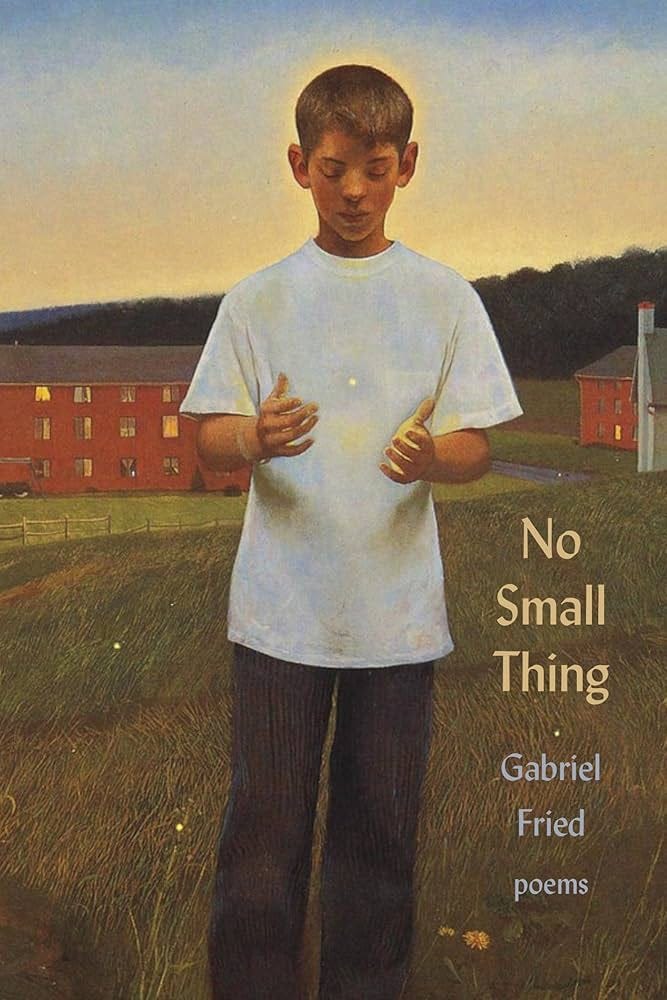
[James Allen Hall] In the last part of your book No Small Thing, in a poem called “Introduction to Poetry,” you write that “shadow makes a sculpture into song,” and I’m wondering what you see as the shadows cast over this book that causes the speaker to break into poetry? I can see a return to childhood and identity formation and revision (particularly around gender), a struggle with faith as a way to revise the narratives that conscript us, and the turn toward art and language as a tool to, as you write in another poem called “Manifest,” “retrace our steps, in search of what we must have missed.” Though, importantly, that last sentence is actually a question in the book.
I love the idea you present of the shadows causing the poems’ speakers to break into song. When I think of the shadow in “Introduction to Poetry,” I think of the poem eclipsed by the shadow of visible, extant poem — but the way you describe it is more magical, as if it animating the poem from behind or above, or even within: like a possession.
One of the most enduring things I learned from Lucie Brock-Broido (who used to talk about “shadow poems” in her workshops) was that something in a poem can be truthful without being factual — and that just because something is factual doesn’t mean it is convincingly true within the context of a poem. This seems kind of obvious, given poetry’s timeless engagement with metaphor, and yet it is something I find myself needing to remind myself of regularly: poetry is not an inherent marker of anything empirical so much as it is an imprint, a convention of echos, of intricate pressings. Even a declaration of fact in poetry is metaphorical or, at least, circumstantial to truth.
In some ways, if the fact of many of the poems is a return to childhood, the truth lies in never really having left its certainties (of centrality and self-made ritual) and fluidity (what we might call queerness), in spite of the world around us insisting that we must shed those qualities.
Does this answer your question at all??
It absolutely does. You make me think of gender or identity as less (pardon me for using your very apt words here) “a declaration of fact” but something that is “circumstantial” — an “imprint, a convention of echos.” I was fascinated by “Hart,” the poem that opens No Small Thing, and how you create a form that allows divergent gendered lives to inhabit the same poem. Why does this poem open the book? Is gender a self-made ritual for the speaker in this book?
Gender, and even biological sex, is in many ways an imposition that many of the poems in the book reckons with. I am very moved by and in synch with the critic Kathryn Bond Stockton, who posits that children are de-queered — and that queerness, as we often think about it, is in fact a natural state, with gender a divergence and (from a certain point of view) transgression. Even our biologies are formerly un- or transsexual in utero. The speakers of these poems mostly don’t know this exactly, but they deeply sense it, and often try to recreate the multiplicity of sex and gender with the limited, imperfect tools that language gives them.
As a poet, I struggle sometimes with how to convey these things via the two-dimensionality of text on the page. Even “Hart,” the poem that most expressly takes up the fluidity of gender, presents gender as a binary. Still, I think the poem tries to get at the openness and blurriness of gender through both the distinctiveness and the overlaps of its speaker’s facets. It’s a poem that might benefit from some 3D modeling to give it an even greater sense of the speaker’s multiverse of selfhood, but the two entwined self-portraits was what I could fathom, given the limits of the page.
“Hart” didn’t always open the book, but once it landed there, I couldn’t imagine it anywhere else. I think it strives to portray the expansiveness of the self and both the possibilities and limits of language to represent that expansiveness. It also seeks to merge the deeply embodied existence of childhood with the displaced verbalizations of self we are forced to accept as identity as grown-ups. In that sense, I think it sets the tone for how to think about the rest of the poems in the book.
The other night, I gave a reading with my dear friend and collaborator Gaby Calvocoressi, who has written so movingly on existing in the world in a gendered/transgendered/nonbinary vessel. We closed the reading by performing “Hart” together, with Gaby as the left-hand aspect of the poem — the boy — and me as the girl (though I hope each aspect comes across as living in a nonbinary space). The performance, for me, was so poignant. I’d been performing the poem myself at readings and it doesn’t do the poem or its polyphonic impulses justice to my ear. It seemed to resonate with the audience, too.
I’d love a 3-D modeling of “Hart,” because I do think that the ways in which the lines revise each other gesture toward multiplicity that explodes the gender binary. “Hart” opens the first section of the book; “The Majesty of Piero della Francesca” closes the section. I read the poem as both elegy and ode to gendered bodily experience, and what transcendence art may afford us. Could you talk a bit about the expansiveness of that poem and the painting which it references?
I guess if “Hart” is an attempt to convey the inherently nonbinary existence of childhood, “The Majesty of Piero della Francesca” laments the effortlessness of that most natural condition. The fresco described, La Madonna del Parto, is located in the village of Monterchi, whose residents (especially the childbearing residents) are so devoted to it that over the years they have successfully blockaded against efforts to relocate it to Milan or Florence. If I have always been in the thrall of older boys, as the first section of the book details, I have also always needed desperately to be invited into the convent/coven/covenant of girl- and- womanhood — and also, deep down, disconsolate that I ever even needed an invitation. The thing about that Piero fresco — about Piero’s artistry in general — is that, like a poem, it captures the cusp of a happening (historic, spiritual) to the point where it’s difficult to discern the narrative momentum portrayed. Do I get to enter the tent? Truly? Or am I being turned away — yet again. If ever a painting captured my relationship to gender, it’s this one. (Hashtag lol facepalm crying face.) But at least both times I’ve seen the fresco, I have felt momentarily welcomed into a space I would love to belong to.
It’s becoming clear as I give readings that “Hart” and “The Majesty of Piero della Francesca” are the major poems in this book, which isn’t to reduce the book to them. But the other poems tell stories cumulatively or slant, whereas these two poems feel like the poles that hold up the tent, if that makes sense.
I think of those two poems working as tentpoles, giving the speaker space and hope for transformation, even if the speaker isn’t sure it’ll be granted. In reading the book, I kept thinking that longing might be its own form of hope. I think poems later in the book — particularly “Correspondence from Madam Rachel, Purveyor of Eternal Youth, to Mister Walter Potter, Anthropomorphic Dioramist” and “Man’s Emotional Support Marmoset Disrupts Las Vegas Flight” — as doing similar space-making work. The titles are humorous, and while there are comic moments in these poems, they also are such sweeping declarations of selfhood. These play off of more painful poems in the world of boys and men, where faith often leads by or to fear. I’m thinking of the poem voiced by a grandfather, who commands us to “[l]ook at that goddamn boy out in the field,/ a goddamn evangelical in love/ with his goddamn fancy. His parents named him Gabriel, so what do you expect…” And in “Vision,” when the speaker says he sees God “by the toolshed/ when the nail came through my sneaker.” It feels like belonging to the world of men, be they men of family or of faith, is pretty precarious. Care must be taken to check one’s thrall. Nowhere is this more evident than in your poem “The Pastor” which ends, “The pastor is a godly man–men who fish usually are./ Still, he’s a man. I watch him in case some part’s rotten.”
How does “thrall” serve the speaker, or how does the speaker’s thrall transform over the course of the book?
First, I really appreciate you seeing something profound in the poems in the book’s third section. Sometimes I worry that they are too fanciful. But maybe something of Lucie BB’s truth/fact distinction manages to come through. They are poems about trying to find acceptance, about trying to fit — physically, emotionally, and socially.
I think that thrall is one of my favorite existential notions because it is ultimately an ambivalent state. Describing something as enthralling is generally meant positively, yet to be in someone or something’s thrall is being held under its power against our will. I think of staring at people as a child, captivated but also with the feeling that I couldn’t look away. (I remember being in locker rooms as a child and seeing nakedness — boys, women, men, depending on my age and who was escorting me — and not being able to look away. Rosemarie Garland-Thompson has an entire, glorious critical book on staring at people…)
When the book’s speakers are younger, thrall is a projection of their own sense of importance — their certainty that they are central to the world’s behind-the-curtain magic and mysteries. As they age, that certainty weakens; they lose that sense of centrality, aware that the thrall they felt as small children is no longer as captivating or convincing. By the time we get to the Piero poem, there is a longing simply to be included in the scene.
Does the triolet form, used brilliantly in many poems throughout the book, play into this notion of being ensorcelled, enthralled? Can you talk a bit about your history with this form, and how the triolet (itself no small thing, even though comprising just 8 lines) fits with the themes of the book?
Ensorcelled is such a great word (and it’s especially apt since I just had my bimonthly, all-day D&D game — it’s a campaign that goes back about 40 years!)
Writing triolets indeed feels both like casting and being subject to a spell, albeit one that can easily go awry because of the tiny margin for error the form permits. You’re past the point of no return almost as soon as you’ve begun writing because of the importance of the recurring first two lines; they have to be powerful on their own but also either syntactically flexible or worthy of repetition. In a certain sense, it’s not a difficult form to complete, at least not for me, but it’s as likely to produce a dud as a gem. Maybe that’s true of any poem, but triolets don’t allow for missteps and they aren’t easy to fix once you’ve bungled them.
I tend to write triolets when I am short on time and ideas, finding my way into them by effectively mesmerizing myself with phrases that I stumble on: “We were thin for different reasons” or “The little god has grown,” to quote from two of the triolets in No Small Thing. In general, I am drawn to poetic forms that approximate the ominous powers of certain nursery rhymes, and I think triolets have that potency. But I also think they underscore the childlike sense that certain phrases or combinations of sounds hold power — that repeating a password or magical phrase (e.g. there’s no place like home) can activate (or deactivate) a power within us that we don’t ordinarily have access to. That’s one way in which I think the form is right for No Small Thing and its preoccupations with longing and hope that you mentioned previously.
Interpolation feels important to the world of your book. Alongside your diction’s rigor and precision also exists an estimation that there may be other possible truths to say. “Finally,” you write at the end of “If I Die Before I Wake,” “will no one say you mean small/ when I say when I was young?” I’m also thinking particularly of your poem “Creative Nonfiction” and its five lines:
Here in the moment
of interpolation
(the god climbing in
to the animal’s skin)
I claim my stake.
The stake claimed might be the one that opens the skin for god to climb in; might be the risk or bet on which identity is predicated; might be the investment or interest or even the whole “I” that is claimed. Small is not young, and young is not small, but putting them into a conversation gives us questions of power — of being corrected, of being revised.
The litany that comprises your poem “One Is” is another example of interpolation: the gesture of the list is that it could be endless. Or, another example is in your ending poem, “Persona,” where the speaker says, talking about wearing the masks of portraiture, “of all the pornographies/ this is my favorite.”
Can you talk about how the book seeks to upend power dynamics by making space for the unseen or unheard subject through wordplay, particularly through expectation and surprise?
Among other things, poetry has always felt to me like a way of reclaiming power through syntax, (including through enjambment and lineation, which I think of as part of poetry’s syntax). I hate hate hate language shaming. I grew up hearing language used as a way of correcting and humiliating others, a way of reinforcing hierarchies and/or forcing those who don’t speak or write a certain way to accept those hierarchies out of humiliation or fear of losing standing, whether academic, social, or familial. I think the interpolation you pick up on is a way of pushing back against the idea that speaking “properly” takes priority over communicating authentically, as if language is something sacrosanct rather than a means of forging essential connections or differentiations.
I also think — and this speaks to other things you’ve observed in the poems — it feels important to me to explore how the powers felt in childhood connect inversely with a sense of dislocation or disempowerment often felt in adulthood (when we are given less space to play out disappointment and perceived unfairness). In some ways, we have fewer reflexive coping mechanisms in adulthood than we do in childhood. We’re expected to age out of certain ways of responding to the world around us, but most people have trouble arriving at healthy new systems as they mature, which results in the pathological patterns that lead us to feel stymied, unfulfilled, or distressed. At least, that’s how it seems to me. Somehow, poems feel to me like the right way to explore ways in which childhood never leaves us and adulthood is never explained to us.
Childhood is never fixed, never done, the book seems to argue, since we’re always reinterpreting it and, through those re-understandings, interpolating it, reliving it to some degree. I’m fascinated by your poem towards the end of the book, “Correspondence from Madam Rachel, Purveyor of Eternal Youth, to Mister Walter Potter, Anthropomorphic Dioramist.” I think the fascination is that the poem encapsulates one of No Small Thing’s central tensions: the never-finishing of childhood and the stasis Madam Rachel wants. How does this poem begin to resolve your book’s emotional argument about how to inhabit the past and the present (to say nothing of making a future possible too) in the same moment?
For context, that poem is in the “Lucie” section of the book — that is, the third and final section, which came about in tribute to and communion with Lucie Brock-Broido after her death. Lucie, I always thought, was a masterwork of self-creation, like something beautiful and tactile behind velvet ropes that you come across in a museum and remain in front of, transfixed and out of time. She had a grown-up’s savvy, a boisterous and husky voice, but she was, in presentation at least, a bit like an chic Edwardian school girl; her perpetual girlish costume was meticulously curated, in a way only an adult could conceive of, manage, and maintain (not to mention afford).
I think, to answer your question, that the taxidermy poem resolves the book’s emotional argument by insisting that it never resolves. We carry our childhood present with us throughout our lives and into our futures. It can be a source of visceral joy but also inescapable unrest; it can grant us admirable self-possession and grace, but also psychic rigidity and awkwardness. (Walter Potter was, by the way, a terrible taxidermist: his animal subjects were wrenched and broken, belying the cuteness of their previous, living forms and the quaint scenes they were made to inhabit in perpetuity.) I liked the idea that Madam Rachel, a charlatan who hawked formulas of perpetual youth, would be drawn to Potter’s twee scenes of critters forced falsely and grotesquely into their poses. It both misses and makes the point: we can’t ever be the children we were and yet we are propelled to some extent by our identification with (and alienation from) our childhoods, by way of our imaginations and nervous systems.
What are your metaphors of making, Gabriel? Is poem-making a kind of nervous system, a circulatory system…or perhaps some other body system? I’m interested in how the book’s poems circulate and transform arguments about self-making, about survival, about return. In that way, the book feels very contained and yet open, a body and yet a porous body.
Ah what a good and complex question (especially complex because I’m not sure how precise my notions of nervous and circulatory systems really are!).
I’ve always been struck by the idea of our blood’s deployment from our heart to our extremities, and its return to the heart — winded and blue in the face, so to speak — after making its essential delivery of oxygen. And poems have heartbeats, right? Mine are almost always driven by one, and the iamb (da DUM) is a heartbeat on so many levels. Existentially, I don’t know if I can separate the circulatory and nervous systems though: the way the heart races when we’re activated and slows when we relax. I know that, physiologically, they are distinct, but experientially they feel so interconnected.
How do you know a book is done? If it’s a different experience, how did you know No Small Thing was completed? And do you have any advice, from the poet’s and from the editor’s perspectives, for poets who are finishing, polishing, building a complete book? What qualities does a completed book show?
No Small Thing evolved into three discrete sections, so I was able to focus on the tropes and microclimates of each, in addition to thinking about how the collection was shaping up holistically. I don’t know if this helped me know it was done (is it done?), but it gave me parameters for fleshing out its landscapes and preoccupations.
To me, a completed collection is more than the sum of its parts — that is, there is something in the cohabitation or accrual of the individual poems that create an idiom or atmosphere that might not exist otherwise, even if the poems read well on their own. And yet there has to be a cohesiveness or coalescence among the poems. As an editor at a small press, I have received tens of thousands of manuscript submissions, and they often have one of two shortcomings: the first is that the poems, even if they’re all well made, don’t accrue toward something magical as a group, which ends up making poems feel redundant with another; the second is that there is too much variety, whether of subject or form, which can make the collection difficult to inhabit or connect with. So whatever that elusive sweet spot is, that happy medium — that’s what I hope for as a poet and as a reader.
poetic conversations: The Cusp of Happening: An Interview with Gabriel Fried was originally published in ANMLY on Medium, where people are continuing the conversation by highlighting and responding to this story.