
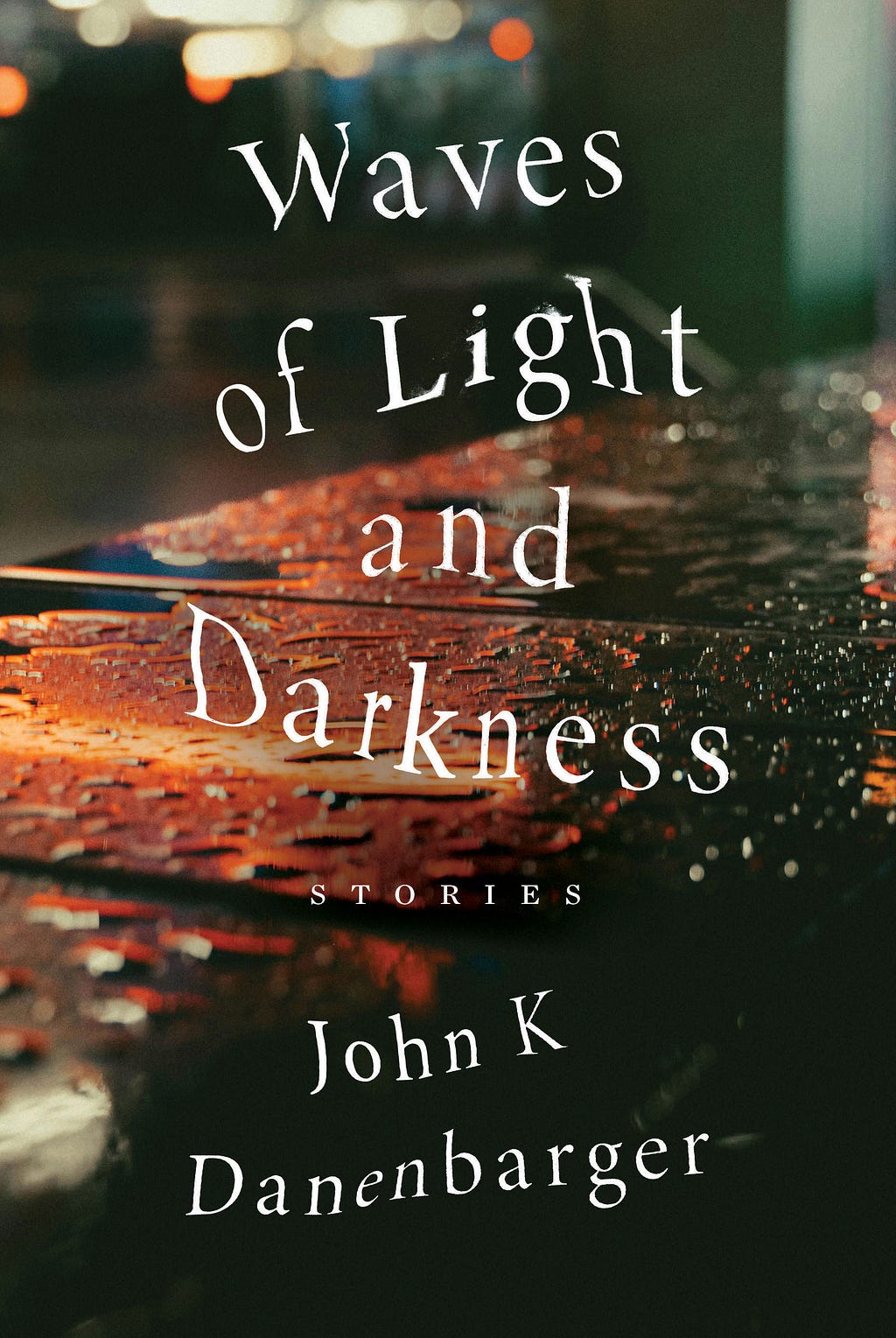
From Camus and Kafka to Beckett and Ionesco, absurdism has always been one of my favorite genres to read and re-read, to turn to in chaotic and troubling times — whether on a small or massive scale. It brings me comfort to revel in the existential dread, frank honesty, dark humor, and bizarre situations that absurdism demands. For me, these characters serve as meaningful company in a meaningless world.
Reading John K. Danenbarger’s new short story collection, Waves of Light and Darkness, provided me with that same release. His stories, many of which are surreal and play with the notion of who and what defines reality, are intellectually rigorous, surprising, and unrelenting in their interrogation of violence, grief, and death — all against the backdrop of a universe that is largely indifferent to suffering. Danenbarger shows off his range in these stories, transporting readers to the past or near future, to a Kansas farmhouse or a potentially supernatural cave, often utilizing an unexpected point of view, such as stories from the perspective of a cat, a coma patient, and a ventriloquist.
I had the pleasure of talking with John K. Danenbarger via email. We spoke about the absurd, Albert Camus, humor as “joyful recognition,” the difference between a writer employing the male gaze and a writer interrogating it through character, and much more.
Mindbuck Media: You refer to these stories as both literary fiction and existential fiction. I also saw that you are heavily influenced by Camus, which makes sense. Could you tell me more about existential fiction, specifically, your love of it, and why you write it?
I’ve always felt that a writer shouldn’t insult the reader by telling them what they’re reading. It’s a matter of respect, really. If the universe doesn’t provide a manual for living, why on earth should my stories provide a manual for reading?
I’m trying to invite people into the same vacuum of meaning my characters inhabit. I don’t want them just observing a “crisis”; I want them to feel the actual weight of having to interpret one. To me, existentialism is about an abundance of meaning. It’s the idea that every choice made in the face of the Absurd is a rebellion.
Camus taught me that the Absurd is the only honest starting point, and I love this genre because it strips away the “fables” and leaves me with the raw fact of being alive. I write to find that specific moment where the reader realizes I’m not going to save them. They have to save themselves.
I’m obsessed with the why, or the lack thereof. The “literary” side is the craft; the “existential” side is to leave the questions unanswered. On top of everything else, I get excited when I write. It makes me want to get up in the morning.
I love what you said about not providing a manual for reading. So much of the joy of reading, for me, comes from the work I have to put in on my end. It’s part of the experience.
In the story “Death of Angst,” written from the perspective of a cat, the cat says, “Reality may not be reality.” I was really taken with the way you play with reality in this collection. Across many stories, characters question their reality, face a contradictory reality, or realize the malleability of it. Could you speak more to this theme and your interest in it?
In the case of the cat, or any of my characters, it really just comes down to point of view. We all move through the world assuming there’s a subjective norm or a kind of shared reality we can all agree on. But I think a story only gains meaning when a character sees the world differently enough to challenge that norm. If a character’s POV is skewed, or if they’re simply seeing the world without the usual filters, then so-called reality starts to look a lot more interesting. It’s not a grand philosophical trick; it’s just the reality of being an individual and of me being a storyteller.
This collection so beautifully blends existentialism, death, grief, and loneliness with deadpan humor. I loved this moment in “The Remainder,” when you write, “What Wilfred really thought about the truth was that truth was subjective for some people depending mostly on their education and how large a section of their brains they had walled off to maintain their childhood fantasies, never to be touched by fact.” There is real insight there, but it is also funny. How important was it to you to interweave these stories with humor? And why?
It’s interesting you found that line funny. I actually don’t see it as especially humorous myself. But I take it as a great compliment. To me, that reaction happens when a point hits the nail on the head so cleanly that it creates a sense of joyful recognition, or even a release. It’s the difference between hitting the nail and hitting your fingernail.
Readers and critics often tell me I’ve “interwoven” humor into these stories, but I don’t really think of it as a separate ingredient I’m adding to the mix. It’s just a byproduct of the perspective. If you look at human behavior without the usual childhood fantasies or protective filters, the result is often absurd. And the absurd is naturally funny.
Even if my wife gets tired of it, I do try to bring a certain relevant wit to my daily life, so it inevitably bleeds into the work. It’s not a strategy; it’s just part of the writing. It’s just how the world looks when you’re being honest about it.
Yes, the joyful recognition and release! There’s hardly a feeling like it. That said, much of this collection is perhaps about the failure of recognition. In “One Day in the Universe,” the narrator, Helen, asks, “From where does the urge to be known arise?” This feels like a theme across the collection: the idea of existential loneliness, isolation, and, importantly, misunderstandings.
The urge to be known is the fear and realization that a person’s short time between non-existence and non-existence means non-existence, unless that person leaves a tiny mark or tattoo on the earth. And in Helen’s case, she realizes even that tiny mark is futile since the Earth is a speck of dust in an absurd, cold desert.
There are many, let’s say, ignorant men in this collection who seem to willfully misunderstand the women around them (I’m thinking of “Seduction” and “Love, It Isn’t”). Could you speak to your process in writing these men and the male gaze, i.e., reducing and flattening women to objects of desire or spectacle?
This question requires a dissertation. A fundamental distinction to be made: there is a difference between a writer employing the male gaze and a writer interrogating it through a character.
In these stories, I am often pushing the boundaries of the “ignorant male” because that is where the friction is. If a protagonist is willfully ignorant or emotionally stunted, it would be a lie to have him suddenly describe a woman with profound, soul-deep nuance. He doesn’t have the tools for it. To have him see her clearly would be to break the character.
Most of my readers are women, and I think they have a high “B.S. meter” for poor characterization. They know when a writer is being lazy versus when a writer is accurately depicting a man who is being lazy. By leaning into that ‘flattened’ perspective, I’m not asking the reader to agree with the man; I’m asking them to witness the architecture of his ignorance. I want the reader to understand how some men think or, more importantly, what they refuse to think about. It’s about the reality of the vacuum, not the endorsement of it. In “Seduction” and “Love, It Isn’t,” this flattening reveals the cost of ignorance.
I also think it’s important to distinguish between the “male gaze” and sexual explicitness in stories. The two things are often conflated, but they shouldn’t be. My perspective on this was shaped by a massive cultural shift in my own life.
I grew up in “Bible-belt Kansas,” a place where sex was often treated as ‘dirty’ and the human body was something to be hidden or ignored. It was a culture of hangups. But when I moved to Scandinavia, my entire concept of life changed. There, I saw a society where violence was censored, but sex was treated as natural. Example? Having grown up where I was supposed to be married to have any sexual contact, I was shocked when a Norwegian daughter asked her parents if she and her boyfriend could use their cabin for the weekend. And, on top of that, the answer was yes. More importantly, I saw a society where women were actually equal to men, both at home and in the workforce. And sexually.
That experience stripped away the fable of shame for me. When I push the boundaries of explicit sex in my writing, I’m not coming from a place of ‘macho’ conquest or abuse. I’m writing from a place where the body is a fact and not a secret. To me, being explicit is a way of being honest about the human experience. If I’m portraying an ignorant man, his “gaze” is the problem, not the presence of the sex itself. I’m interested in the reality of the encounter, not the ‘dirty’ version I was taught as a child.
I truly loved the sexual explicitness present in some of these stories. I love what you said: the body is a fact and not a secret. That shamelessness comes through in beautiful ways.
One of the things I love about short story collections is the narrative arc that is revealed through these many stories, realities, and universes. I think there were many ways you could have ended this collection, which is often so dark and sad, but you chose to close out on a meaningful, tender, happy moment between father and his children. I am suspicious of “takeaways” for books, but I was wondering: what do you think readers might walk away feeling or having taken from the experience of reading this book?
I will give you a confession. I am glad you are suspicious of “takeaways.” Providing a takeaway feels too much like “teaching,” and I would much rather the reader live the experience alongside the protagonist.
Human history is essentially a short, aggressive burst of evolution moving from microbes obsessed with reproduction to a species that builds complex, fanciful systems to justify its own dominance. We have spent our history constructing norms, religions, traditions, and social hierarchies to convince ourselves we are more than just clever animals driven to survive. In my fiction, I like to turn those norms back on the characters to reveal how flawed and fragile those norms truly are.
I write to find that specific, uncomfortable moment where the reader realizes I am not going to provide a literary rescue. There is no narrative safety net. They have to save themselves.
But if there is a rescue to be found, it is in other human beings. We have nothing else. When I feel close to my friends or feel the love of and for my family, I find a localized meaning within the absurd. The book does not save the reader, but it might clear away the “fables” so they can finally see the people standing right in front of them.
“The Absurd is the Only Honest Starting Point”: An Interview with John K. Danenbarger was originally published in ANMLY on Medium, where people are continuing the conversation by highlighting and responding to this story.