
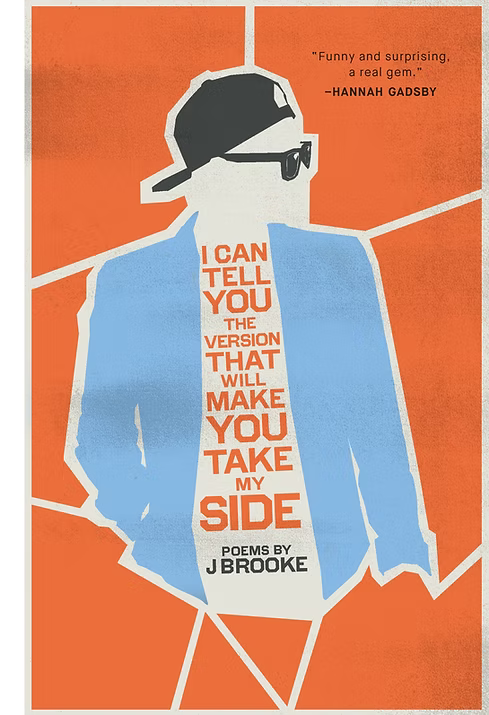
Repeating lines in a poem (or throughout a poetry collection) can act as a heartbeat or pulse — constant, strong, insistent — that emphasizes what the writer wants the reader to know or feel. Appropriately, the following lines are repeated in several poems in J Brooke’s debut collection I Can Tell You the Version That Will Make You Take My Side:
“I can tell you the version
that will make you take
my side — but I’m not
going to tell you that
version.”
The poems in Brooke’s book take readers on a guided tour of the speaker’s life. It starts with a childhood where their gender identity was ignored and leads to an adulthood where they fully embrace their trans and nonbinary identity. As the title says, Brooke knows they can write the version that will make readers take their side, but they choose the naked truth every time in this electrifying queer collection.
Brooke begins by painting a picture of the speaker’s troubled childhood. With an absent father and a distant mother, the speaker’s youthful sorrow is compounded by their despair and discomfort at being forced to assume a girl’s identity. Several poems feature the speaker chafing when called “a lady” or told to behave like one.
Brooke’s speaker contemplates suicide as a young child, but ultimately decides against it. They say in “Exit Strategy”:
ㅤㅤㅤㅤㅤㅤㅤㅤㅤㅤㅤㅤ“I now knew
something —ㅤㅤㅤㅤI now held the power to control one perfect thing
in my life — even if it ended up becoming the last thing ever in my life.”
Childhood can be a time when even children with all the advantages in the world feel powerless or helpless. Kids have very little control over things, as the rules for their lives seem immovable. For a trans or nonbinary child, these feelings of overwhelming vulnerability can be even more extreme. When someone’s assigned gender doesn’t match their feelings and self-perception, it can worsen the pervasive sense of helplessness. With the elegant lines of “Exit Strategy,” the young speaker knows staying alive is how they can assert their power.
For the speaker of I Can Tell You the Version That Will Make You Take My Side, their childhood was one of financial privilege but emotional neglect. In “Before Surgery,” the speaker describes how their mother forced them to get a nose job when they were a child: “My nose not mine to decide about / is how mom explained signing me up / for surgery as if a manicure.” With this extreme example, it becomes clear that the speaker had even less control over their own body and appearance than most children.
One might imagine a trans or nonbinary child would have ideas about how they’d want their body to be different. But for a parent to decide to change the child’s body against their wishes is deeply upsetting. The first poems in Brooke’s collection ache with this powerlessness and lack of familial understanding and boundaries.
As the speaker comes of age, they contemplate not just their gender identity but their sexuality. In the dreamy poem “Bumper Cars,” Brooke’s speaker describes the jostles of riding in bumper cars (“pleasure / via violent collision”) as akin to having sex with men. On the other hand, the speaker rhapsodizes about sex with women: “female body / plus female body / always merging // versus colliding / languid surging / devoid of violence.” The wonderful rightness the speaker finds with female bodies slides another piece of their true identity into place.
The second half of Brooke’s collection (subtitled “Not Getting Top Surgery”) features poems on not only the experience of living in a trans body and identifying as nonbinary, but on how these identities intersect with the current political climate.
“I Am the Gulf of Mexico” is an early poem in this section that takes the U.S.’s current authoritarian government to task. It lays out the horrors of the January 6 riots, the evil actions of ICE, and the U.S.’s callous and abrupt ending of USAID.
Brooke’s speaker proudly declares:
“I am Birthright Citizenship
University Autonomy Abortion
Rights
I am the USNS Harvey Milk,
ㅤㅤㅤㅤa shadow
of a former selfㅤㅤㅤㅤ I am
ㅤㅤㅤㅤa Covid-19 vax
I am Gender Affirming Care
ㅤㅤㅤㅤlooking
to affirm my gender anywhere
ㅤㅤㅤㅤㅤㅤㅤㅤI am
a refugee seeking asylum
ㅤㅤㅤㅤdiscarded
as a paper straw.”
Brooke skillfully weaves together different threads of who is threatened under the current U.S. government. As this administration rolls back decades of progress for queer people, immigrants, BIPOC and science itself, Brooke’s speaker still stands strong for what they believe in. The current secretary of defense may have renamed a naval ship that once honored LGBTQIA+ rights pioneer Harvey Milk, but Brooke’s speaker refuses to be silent and let Milk’s name be forgotten.
Brooke transitions from “I Am the Gulf of Mexico” to “Private Albert Cashier,” another poem that addresses politics and the military. The speaker describes a phone call with their mother. The speaker tries to share their excitement about “learning how much [they] have in common / with Albert Cashier,” a trans solider who served in the Union Army during the U.S. Civil War.
In Albert Cashier’s case, they were able to wear a uniform that fit them. But the speaker notes that their mother made their housekeeper wear a uniform, as if to separate her from the rest of the household. The speaker’s mother also made them wear a “uniform,” misidentifying them as a girl and severing the speaker from their true trans identity.
The speaker also addresses their father’s denial of their identity in “When I Came Out to You.” They express their frustration at his feigned ignorance, remembering: “Hating you / teasing me, saying I wanted to marry Joe Namath — / yeah no. I wanted to be Joe Namath and you knew it.” The speaker seems to be inviting readers to ask why some parents force their children to come out to them — when they know deep down who their child really is.
While looking back at their childhood with the wisdom of adulthood, the speaker imagines what could’ve been in their poem “Packer Short”:
“I smile now seeing / another version of myself / at fifteen floating through / a sultry afternoon wearing / nothing but packer shorts, / sipping my big blue Slurpee.” Wearing the “right” swimwear as a proud trans adult makes the speaker reminisce about the possibilities they would’ve had as a child if their identity had been accepted and embraced by their parents.
In the second half of I Can Tell You the Version That Will Make You Take My Side, many of the poems elaborate on the family the speaker has built with their partner. In “One Just Once I Minded Less About My Breasts,” the speaker (who has given birth to a child) reflects on how they sees themselves:
“I walk ㅤㅤㅤㅤin a room ㅤㅤㅤㅤnot a man
not a womanㅤㅤㅤㅤ I am ㅤㅤㅤㅤamalgam
contradiction ㅤㅤㅤㅤof both.”
Even with their nonbinary identity, the speaker is happy when their baby refers to them as Mom: “I pivot smile big.”
Brooke’s poem “Out Late” reveals that the speaker’s child is also trans. Unlike the poems about the speaker’s own childhood, “Out Late” is full of joy and empathy. While the speaker’s parents denied their child’s gender identity, the speaker and their partner celebrate their child’s identity. Their family had a bonfire where they got rid of old family photos that didn’t reflect their trans child’s true gender identity. That night, the speaker says:
“Wild joy like that night needs to be
protected, so I tuck it tight. Bind it
close to my heart — never risking it
being diluted by a big gender stew.”
As this poem is near the end of the collection, it feels like a balm for the speaker’s own painful childhood. By giving their child the love and total acceptance they were denied, the speaker also helps heal themself. Poetry can create opportunities for non-linear healing.
Brooke’s poems are for anyone who has struggled to find their place, discover their identity or create a family outside of cultural expectations. I Can Tell You the Version That Will Make You Take My Side is a collection that traverses the rocky terrain of growing up trans and nonbinary, as well as the messy, beautiful flowers that can grow out of that ground. As the speaker is able to create their own identity and family, the poems provide a hopeful, welcome respite for readers.
J Brooke’s I Can Tell You the Version That Will Make You Take My Side is available now from Driftwood Press.
Poetic Conversations: J Brooke’s “I Can Tell You the Version That Will Make You Take My Side” was originally published in ANMLY on Medium, where people are continuing the conversation by highlighting and responding to this story.