
poetic conversations: Wading Into The Waters of Fatherhood: A Review of Bobby Elliott’s “The Same Man”
Once, after a Marie Howe reading, I finally got the chance to ask her about her poetic relationship to figurative language, something I’d long wondered about her work. I’ve always been in awe of the way Howe’s poems are often devoid of — or at least not reliant on — metaphor. And, how, when figurative language is present, it is so integrated into the poem’s observation that it is almost unnoticeable. After reading her poem “The Gate” as a response, Howe told me that she is more interested in “looking at the thing itself.”
It’s from this poetic impulse that Bobby Elliott’s debut collection, The Same Man, winner of the 2025 Agnes Lynch Starrett Prize, deftly and honestly navigates the waters (more on that later) of new fatherhood — and examines the poet’s complex relationship with his own father. These poems are acts of looking. Into every crevice of the past and how that past remains present. The collection’s brilliance is in the vulnerability of looking, of observing closely, without judgment. Through documentation, Elliot builds a complex portrait of fatherhood, family, and caretaking.
From the first poem in the collection, The Same Man is unafraid of looking at difficult moments. In “Mondegreen,” the speaker imagines his father’s suicide, mistaking “the sound of a recycling cart / hitting the curb” for the latch of a gate and picturing his father stepping into the backyard to shoot himself. This opening poem introduces a core question of the collection — how fatherhood is inherited, and what it means to reject that inheritance. Elliot achieves this not only through the poem’s central ideas, but also the form itself. “Mondegreen” is written in couplets except for two lines which stand alone. The first standalone line is the pronouncement of the father’s intention: the phrase “to shoot himself”. The second is the last line of the poem, recounting the sound which
I mistake for my father
going through with it: one
awful letter in his coat pocket
to me, another
to my unborn son.
The reader is asked to draw their attention to these two contrasting lines: the father’s threatened suicide (death) and the unborn son (birth). In the middle of both is the poet. The rest of the book — in poems as tender as they are brutally honest about fatherhood — asks what it means to exist in that middle.
As part of this project, Elliott’s poems meaningfully engage with caretaking. The collection is often concerned with an inversion of the normal parent-child relationship, in which the poet is made to take care of his own father. In “Game Plan”, the speaker recalls “there was never time // to hesitate, to waver, his life, / it seemed, always in the balance / and his children, us, / always the ones to save him.” Throughout the collection, it’s clear this caretaking of the father colors the poet’s own experience of fatherhood. One poem about taking home the speaker’s newborn child from the hospital, “When I Am Not Thinking of My Father,” leads into the first line, “and whether / he has a gun / to his head.” This type of connection between the poet’s relationship with his father and his relationship with his newborn son sets the ground for the book’s exploration of inheritance in the context of fatherhood.
The collection wrestles with the fact that, whether we like it or not, the fatherhood we experience is present in the fatherhood we construct when becoming a parent. More importantly, though, The Same Man asks what we are to do with that inheritance. The answer is found even in the structure of the book, with poems about the poet’s new experience of fatherhood responding directly to earlier poems about the difficult father figure. For example, “New Parents” is a clear pairing / response to the collection’s opening poem. Like “Mondegreen,” “New Parents” also pictures an imagined death: “As soon as you’re born, we picture ourselves / dying.” The poem goes on to imagine different ways the speaker and his beloved would die to keep their newborn safe — stepping in front of a pickup truck, drowning while saving their child from a riptide. Unlike “Mondegreen,” however, in “New Parents,” these imagined deaths are a form of caretaking. They are a result of the speaker’s love for his child, and willingness to do anything “to avoid / imagining this house // ever without you.” This reversal of the father’s suicide is indicative of how The Same Man approaches inheritance. As if taking a clay figurine, compressing it into a ball, and reshaping it into a new form — the poems turn the material of the poet’s childhood into a fatherhood that centers the child.
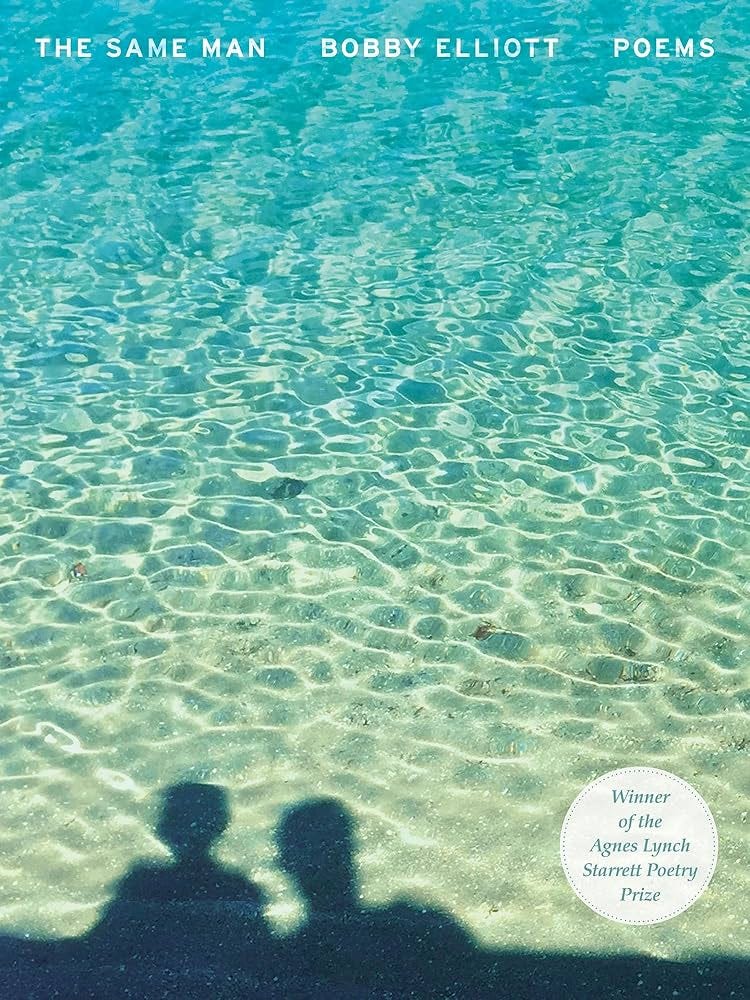
I would be remiss not to mention the role of water in this book. Starting at the cover, which features the shadows of an adult and a child on a clear ocean surface, the book is concerned with water. How it connects, how it drowns, how it cleans. Almost half of the twenty-eight poems in the collection mention water. One of the most telling water-centered poems is “Initiation.” In the poem, the father teaches the child-version of the speaker to fake his own death, floating face down in a pool as if drowned, to scare his mother. Here, the water is a conduit, connecting the father to the speaker as he is initiated into the father’s way of being loved: the threat of death, or of leaving. This poem is also an example of one of the book’s greatest strengths: despite the collection’s clarity on the father’s actions, the poems rarely make judgment statements, instead trusting the reader to draw their own. This approach allows the poems to remain vulnerable and complex in regard to the poet’s feelings toward his own father, even when addressing the pain that relationship has wrought.
In another water-adjacent poem, “Weekend Getaway,” the speaker sits with his newly speaking son on the beach, points to the water, and tries to convince him to say “ocean.” Instead, the son only repeats the speaker’s father’s name: “Papaw.” The speaker observes that his son does not say “ocean or bird or daddy,” and instead focuses on the grandfather who is — as he is elsewhere in the book, and often in the speaker’s life — absent. “Do I wince / because I’m jealous / or am I forgiven / for going quiet?” the speaker wonders. In one of the most vulnerable lines of the collection, which aptly contains the book’s title, the speaker confesses that his attempts to convince himself the toddler’s utterances are a coincidence are facile, “as if I’m unaware / of my own love // for the same man.”
The Same Man is a masterclass in emotional complexity. Where Elliott could give in to easy answers, he instead leaves room for nuance. These poems hold space for love, anger, and pain. Sometimes in the same poem, sometimes on back-to-back pages, but always without apology for or judgment of exactly how the poet feels. This is a type of fatherhood and masculinity that does not fall back into the tendency of the speakers’ father to make others responsible for his emotions, and consequently, survival. Make no mistake — this book is a survival, but it is also a reconstruction and construction of possibility. We as readers are invited into a portrait of Fatherhood which is tender, loving, and honest. We have no choice but to look.
poetic conversations: Wading Into The Waters of Fatherhood: A Review of Bobby Elliott’s “The Same… was originally published in ANMLY on Medium, where people are continuing the conversation by highlighting and responding to this story.