
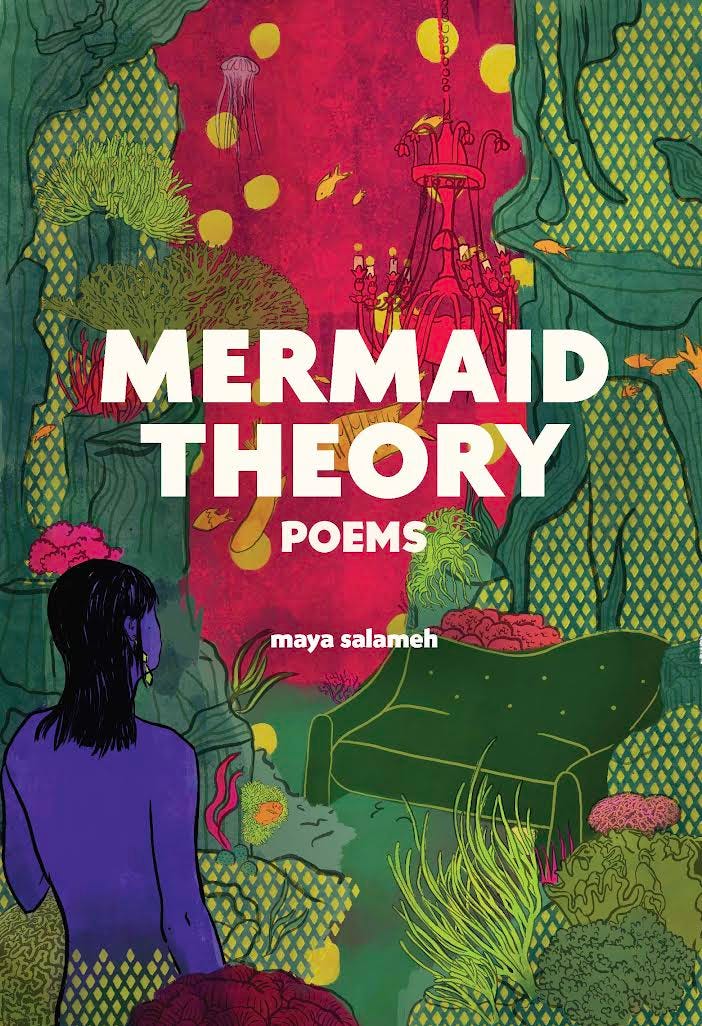
Mermaid Theory by Maya Salameh, reviewed by Diya Abbas.
I need the love poem to humanize myself so I can be a better lover to the world. There needs to be more love poems and every poem needs a Beloved because “every poem is a love poem to something” to quote Nicole Sealey¹. Sometimes turning to our Beloveds can be one of the hardest things to do when our proximity to love humanizes us. It hurts to be human in a world that uses our human to take away the point, the crux, the volta. Our Beloveds turn us to that point, that crux, volta, of that poem.
I need the love poem to humanize a dehumanized world. I need the love poem to humanize the statistics, the chaos, and the possibility of the Beloved with all its glory. In Maya Salameh’s second collection Mermaid Theory I am reminded of the woman, whose myths remember us from sea to sea, field to field, river to river, poem to poem. The woman who is also part myth, who I reach to when I have no archives, no family photos, no faith. Salameh’s collection reminds me that through the page we may lay our stakes in that furious love of the Beloved with patience for the ways of their telling: In the poem Annotated Bibliography:
“I stood there/at the doorway of the story
where I waited and waited.”
In this collection the women, the reader, and the poem turn to look at the mermaid who is every mother, daughter, and ferocious girl — who is “rendered monstrous by the mass of their devotion or love.”² The mermaid shows up when I sing Jill Scott in the car with my homies and in the curious relief of praying to a myth I cannot see. This collection leads us through the myth of Atargatis: the Syrian goddess and deity of fertility who is also the oldest known mermaid myth. It is through the merging of myth, muse, and music that I am able to concatenate an image of a siren from 1000 BC and my n(t)ail tech who provides me the tools I need to survive. In For Every Siren with a Drill:
“you file my thumbs into blades/
pull my hair from its follicles
we launder my knotted parts
& for the next three hours/
our mouths
are stained with the same longing”
These tools are tools of language. In the poem Seismograph,”beauty/is a technology” for our variegated forms of exile. When I cannot return home, I return to the poem. I remember that in these alternative forms of literature, of history, of memory, “I’m safer as a myth than a woman” (Pisces). This love is fractalizing in its possibility to transform our current moment. I am reminded in How Love was Invented:
“a girl meets a girl & they become a quadratic, a proof. a girl meets a girl & parabola of her back at noon, comorbidities of their legs twined together. a girl meets a girl & becomes a biome”
“they make an elegy. this song lasts longer than the mountains & all the horses nearby can smell it.”
I am reminded of Mahmoud Darwish’s collection Why Did You Leave the Horse Alone³? How the horses are left at the homes of those forced into exile as proof that return is inevitable. The horses smell this proof of exile and the proof of return through the remnant subterranean traces of the water, the myth, the legend, and the fable of girl. Every woman is a walking creation myth and in our interactions with ritual, prayer, and the page we can use this malleable girlhood to write a counter narrative against empire’s flattening of our lives. Poetry’s potential lies in this possibility of expansion in the human detail. I am caught in the intimacy of the human in Haggling the Shami Way:
“When she leans over the sink to rinse rice, her shoulder blades poke through her shirt like
prayer wings.”
“Her eyes don’t glimmer. They are a river with no source.”
“His mercury fillings click when he eats fruit.”
Somewhere in the space between such details is where I learn to love my speaker’s Beloveds, I am able to speak to the mermaid to request her ancient lessons of love. In that loving we are able to imagine our lives differently through a “fluvial language”⁴ where active witnessing is not using performative excuses for withdrawal, but instead a politics of care where love is the building block of our social movements. This love humanizes the diaspora by subverting fact, identification, and naming with embodiment, feeling, and being. Can we learn to love our own and each other’s bodies by loving the body of the poem? The proof of both poetry and myth is where our devotion can and can “let me winnow my rage into something of use” (My Country’s Fables Say I am Devoted). Our political moment needs us to respond not to performances of activism in an age of infographic algorithms, but towards forms of love which turn us towards real human life, stories, narratives, and details. This attention is our basic duty.
Salameh reminds us also not to turn away from the contradiction of language which both builds an “Other” through its over- and under- identification, through the verbicide of human life, and simultaneously where the quotidian may survive. This paradox appears through the collection and in Annotated Bibliography:
“For many journalists,
Arab life is worthless. For many investors,
Arab death is worth a lot.”
However, momentarily in the poem, can Arab life be neither? Can it be human? If every poem is a love poem, then perhaps every poem is an “after” poem and is where we can lay our stakes, our glory, by honoring our Beloveds. It is in the detail as ode where perhaps the poem can dress the Beloved in freedom. In Mona Hatoum’s visual art piece, Keffieh⁵, we see human hair weaved on the cotton fabric of the keffiyeh. The poems in this collection share a similar texture through text. I’m left wondering, what does embodied ritual look like through the living organism of the poem? In these poems we are able to wear our Beloveds momentarily so close that our political movements are embedded with the same love as our personal movements. We must move towards this feeling; as Ritual Ethnography counsels:
“god/loves women who make/their own luck”
Sometimes luck is simply made in a vast silence, as the poem Mermaid Theory reminds us:
“sometimes praying is just talking to yourself in the dark.”
Mermaid Theory foregrounds the personhood of the mermaid, reminding us to pay loving attention to all “the minor/prophets the gas station saints, the neglected apostles” (Example Sermon). This love must be painful, it must be inconvenient, it must be hungry and praying for “every girl who lent me shoes.” (Amtrak Devotional). Maya Salameh reminds me that every poem is a girl writing her own creation myth, towards a new telling of our names.
²Voice memo from Salameh 12/29/25
³https://archipelagobooks.org/book/why-did-you-leave-the-horse-alone/
⁴From the poem “Mermaid Theory”
⁵https://www.moma.org/collection/works/153219
Diya Abbas is a first generation Butch Pakistani writer, performer, and playwright from the Midwest. She believes the poem is a clock. The poem makes time. She is currently a masters student at NYU’s Art and Public Policy program. You can find more of their work at their website here: https://diyabbas.com/
The Beloved is Not Abstract: The Devotion of “Mermaid Theory” by Maya Salameh was originally published in ANMLY on Medium, where people are continuing the conversation by highlighting and responding to this story.